The Enigmatic Lure of Black Holes: A Journey Through Space and Time
Black holes, the mysterious titans of the cosmos, have captivated the human imagination for decades. These enigmatic features of our universe represent the ultimate unknown, the profound abyss where the known laws of physics converge in a singularity of infinite density. Recent advancements in astrophysics have brought us closer than ever to understanding these celestial phenomena, yet they remain shrouded in mystery, beckoning us to explore further. The Event Horizon Telescope's groundbreaking image of a black hole's shadow provided a historic glimpse into these cosmic giants, validating Einstein's theory of general relativity in extreme conditions. Despite these strides, many questions remain unanswered: What lies beyond the event horizon? How do black holes influence the fabric of spacetime and the evolution of galaxies? As we delve deeper into these cosmic enigmas, black holes continue to challenge our understanding, pushing the boundaries of science and sparking our curiosity about the universe's darkest secrets.

The Nature of Black Holes
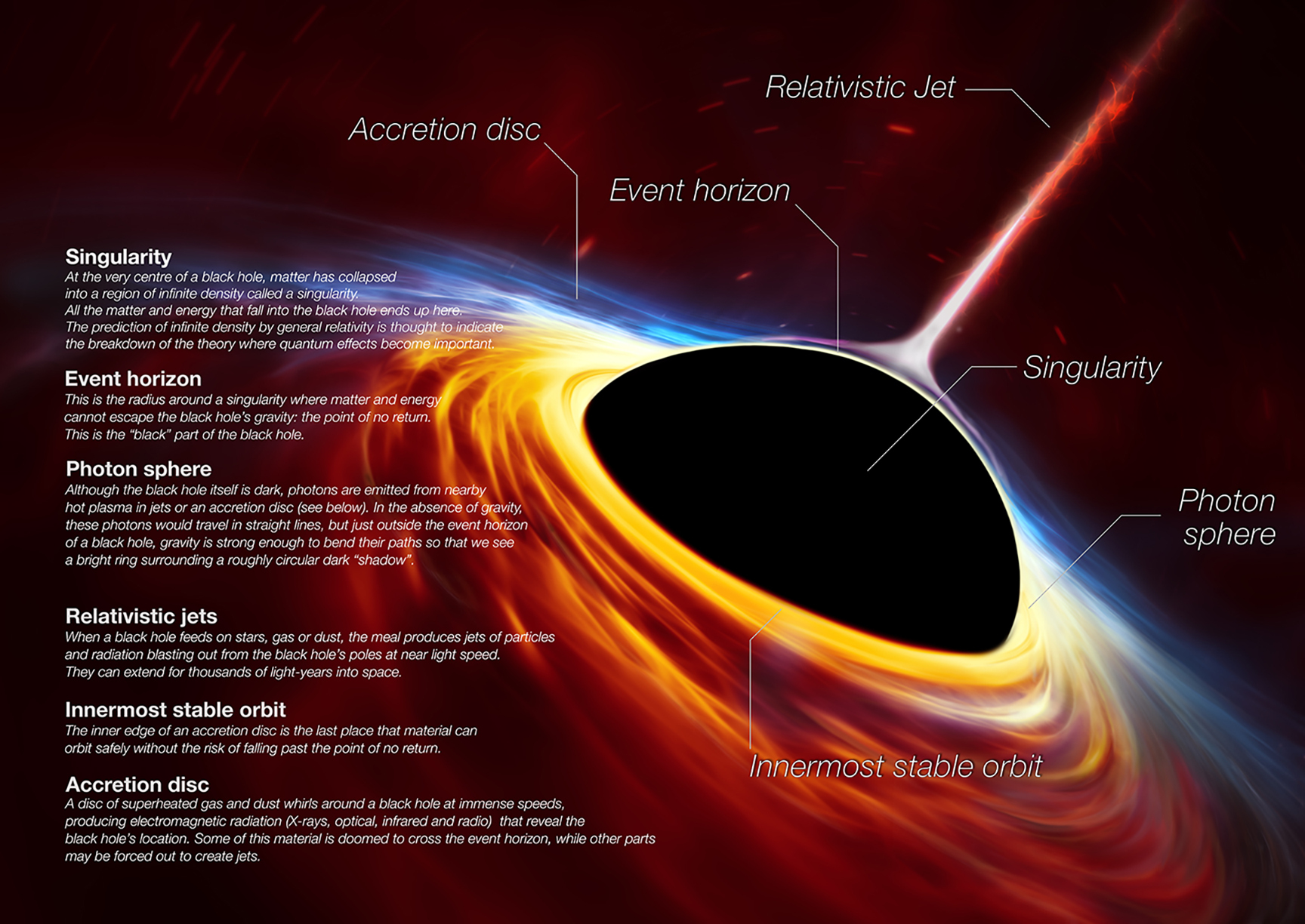
At their core, black holes are regions of spacetime where gravity is so strong that nothing, not even light, can escape their pull. They are the remnants of massive stars that have exhausted their nuclear fuel and collapsed under their own gravity. This collapse leads to the formation of a singularity, a point of zero volume and infinite density, where the curvature of spacetime becomes infinite.
The Event Horizon: The Point of No Return
Surrounding the singularity is the event horizon, a boundary beyond which nothing can return. It is the point at which the escape velocity exceeds the speed of light. The event horizon is not a physical surface but a spherical region marking the limits of a black hole's gravitational influence. Anything that crosses this boundary—matter or radiation—is irrevocably drawn into the black hole's depths.
Hawking Radiation: A Glimmer of Light in the Darkness
In the 1970s, physicist Stephen Hawking proposed a groundbreaking theory that black holes are not entirely black. According to his calculations, black holes should emit radiation due to quantum effects near the event horizon. This radiation, now known as Hawking radiation, allows black holes to lose mass over time, eventually leading to their evaporation. This theory bridges the gap between quantum mechanics and general relativity, two pillars of mode physics.
Observing Black Holes: A Technological Marvel
Observing black holes is a formidable challenge due to their nature of absorbing light. However, scientists have developed ingenious methods to detect their presence. By observing the behavior of stars and gas clouds orbiting invisible objects, astronomers can infer the existence of black holes. Additionally, the detection of gravitational waves—ripples in spacetime—has opened a new window into observing the collisions of black holes.
The First Image: A Historic Milestone
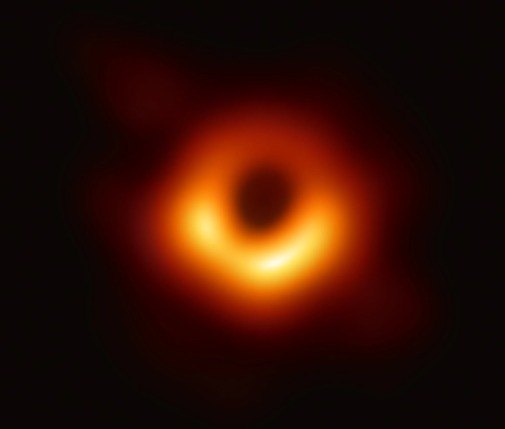
In April 2019, humanity achieved a historic milestone by capturing the first-ever image of a black hole's event horizon. The Event Horizon Telescope (EHT), a global network of radio telescopes, imaged the supermassive black hole at the center of the galaxy M87. The image revealed a bright ring of gas swirling around a dark central void, providing visual confirmation of a black hole's existence.
The Role of Black Holes in the Universe
Black holes play a crucial role in the dynamics of the universe. They are thought to reside at the centers of most galaxies, including our own Milky Way. The supermassive black hole at the heart of a galaxy can influence its evolution, dictating the motion of stars and the growth of the galaxy itself. Moreover, black holes are key to understanding high-energy phenomena such as quasars and gamma-ray bursts.
The Future of Black Hole Research
The study of black holes is an active field of research with many unanswered questions. How do supermassive black holes form? What happens inside a black hole? Can information truly be lost in a black hole? These are some of the mysteries that continue to intrigue scientists. With advancements in technology and international collaborations, we are poised to uncover more secrets of these cosmic enigmas.
Recent Image(March,2024)
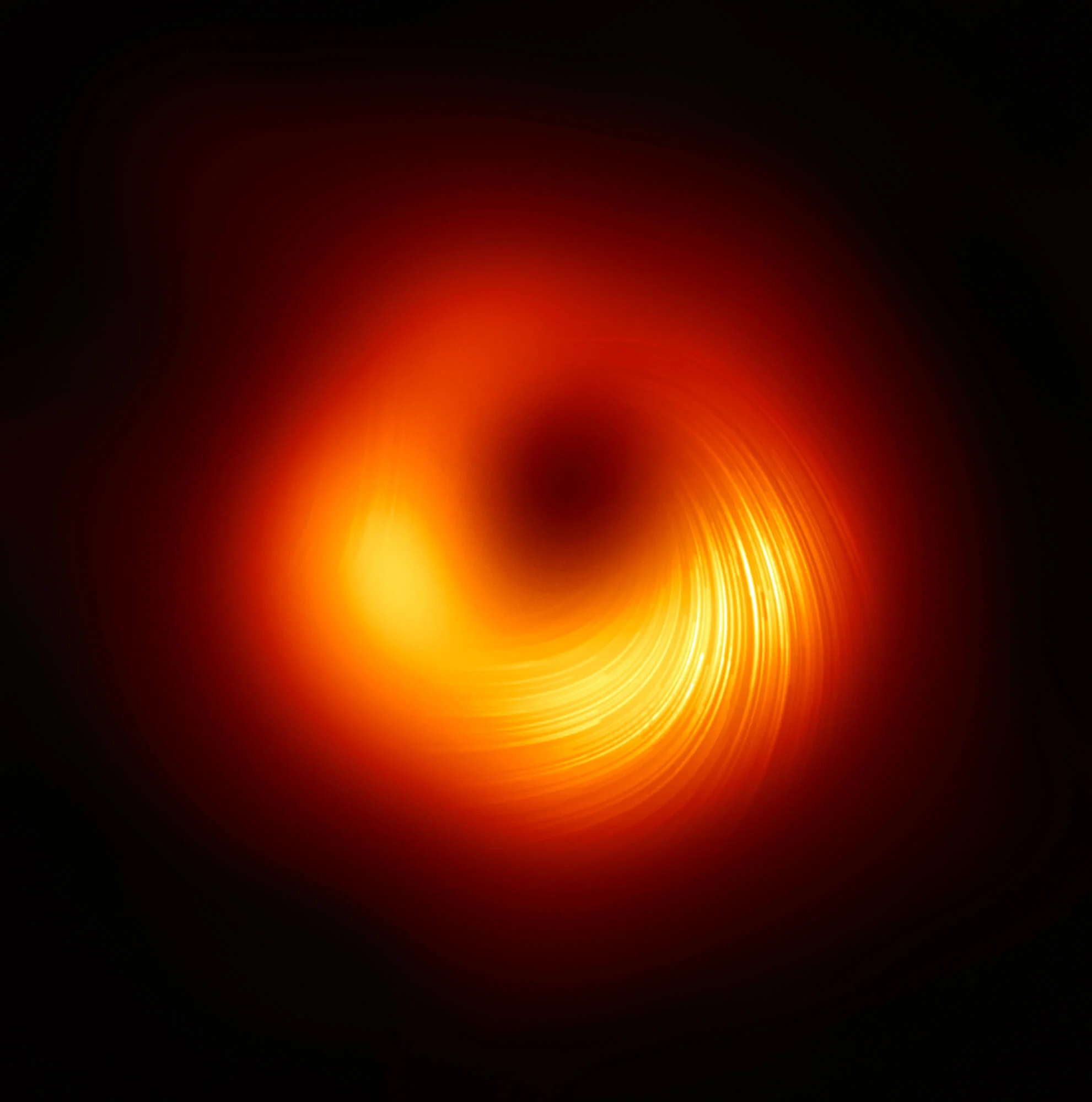
A view of the M87 supermassive black hole in polarized light, as captured by the Event Horizon Telescope Collaboration. This is the first time astronomers have been able to measure polarization, a signature of magnetic fields, this close to the edge of a black hole. The lines mark the orientation of polarization, which is related to the magnetic field around the shadow of the black hole. Photo by the Event Horizon Telescope Collaboration.
Conclusion: Embracing the Unknown
Black holes remind us of the vastness of the universe and the limits of our knowledge. They challenge us to pushthe boundaries of science and to embrace the unknown. As we continue to explore the depths of space, black holes will undoubtedly remain at the forefront of astronomical research, inspiring awe and wonder for generations to come. In this journey through space and time, black holes stand as beacons of the ultimate frontier, inviting us to ponder the fundamental nature of reality. They are not just objects of scientific inquiry but symbols of the human quest for understanding. As we peer into the abyss, we may find not only answers to long-standing questions but also a reflection of our own desire to explore the uncharted territories of the cosmos.